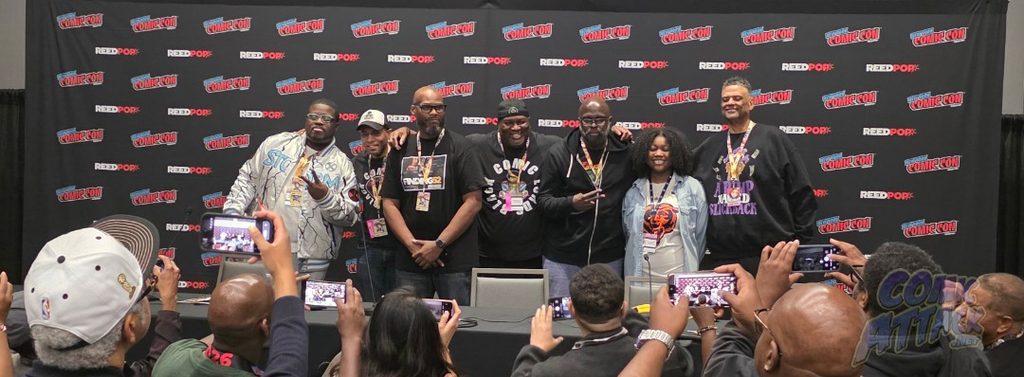
When the Black Comic Lords took over the NYCC stage, the room instantly bypassed polite promotional pleasantries to interrogate the cold mechanics of the sequential art business. Moderated by Sexual Chocolate alongside an assembly featuring BCL CEO and Co-founder Paul White-Davis, Derek the Producer, Stephanie Williams, Sanford Greene, Rodney Barnes, and DJ Big Phil, with Joe Illidge and Denys Cowan present in the audience, the session mapped out a direct blueprint for industry survival centered on absolute structural control.
For BCL, breaking stagnation requires securing access across five immutable pillars: creators, printing, publishing, marketing, and distribution. If you do not control or influence those touchpoints, you are simply renting space in someone else’s house. Sanford Greene addressed the shift in creator profile, noting that true autonomy in the indie space combined with critical accolades has fundamentally elevated how Black creators are perceived and compensated. Ownership is no longer just a philosophical talking point; it is a shield against systemic gatekeeping.
Rodney Barnes offered a clear window into that philosophy when discussing Killadelphia. Growing up devoted to classic Universal Monsters, Barnes noted a glaring absence of Black protagonists at the center of horrific mythologies. Building Killadelphia outside mainstream boundaries allowed him to inject nuanced political commentary and cultural weight that corporate editorial mandates would likely have blunted. Independent voices carry an unvarnished potential for resonance precisely because they answer to no one except the audience.
That audience responsibility cuts both ways. Stephanie Williams delivered a sharp corrective on consumer habits, asserting that the old excuse of not knowing how to pre-order a book has devolved into a lazy crutch. In a hyper-connected media landscape, motivated readers possess every tool required to procure independent work. Word of mouth remains the lifeblood of indie survival, a point Williams underscored by highlighting the grassroots momentum behind projects like Roots of Madness.
The panel also showcased archival preservation and non-fiction documentation. Big Phil discussed the fully funded Kickstarter for Finding 52, a documentary tracking down original art by Jack Kirby and Stan Lee from the historic 1966 debut of the Black Panther in Fantastic Four #52. Unearthing the physical artifacts of comic history is its own form of reclamation.
Friction arrived when the conversation turned to contemporary industry trends. Big Phil pulled no punches regarding creative recycling, stating outright that race-swapping or gender-swapping existing intellectual property is an unnecessary shortcut. The industry boasts a deep reservoir of original Black characters waiting for innovative storytelling rather than hand-me-down legacy slots. Sexual Chocolate echoed the sentiment with blunt frustration over historical erasure.
Closing out with audience recommendations for newcomers diving into Black sequential art, Rodney Barnes laid down a tripartite reading list: an essential indie title in Sanford Greene’s Bitter Root, a major mainstream anchor, and a genre-specific wildcard tailored to individual taste. The directive was clear. Support the pipeline, demand original execution, and own the work from the first sketch to the final box on the comic shop floor.
Christian Davenport
cable201@comicattack.net